
It’s 1 a.m. The house is quiet. You told yourself last week was the last time.
At 7 a.m. you’re making breakfast, signing a permission slip, trying to stay patient with a kid who won’t put his shoes on. Same guy. Two versions. The distance between them is where the shame lives.
If that’s you, you’re in a lot of company. Most men just never say it out loud.
What “porn addiction” usually means
When men search “porn addiction,” they’re usually describing one of two patterns. Often both.
Use that’s out of control. You’ve tried to cut back and couldn’t. It eats sleep, time, and attention. Your relationship is taking hits.
Use that’s in conflict with your values. The amount might be modest. Every time still feels like a betrayal of who you want to be, and the guilt is the heaviest part.
Both are real. Both are workable. They call for different work, so it helps to know which one you’re carrying.
Why the difference matters
The World Health Organization’s ICD-11 includes compulsive sexual behaviour disorder: a persistent pattern of failing to control intense, repetitive sexual urges, with real distress or damage to work, family, or health. The same entry says distress tied entirely to moral judgments about sexual urges or behavior doesn’t meet that bar on its own.
Research lines up with that. Across two studies of more than 3,500 people, Joshua Grubbs and colleagues found that people who viewed porn while believing it was morally wrong were more likely to see themselves as addicted, even when their use was low or average. Over a year, rising moral disapproval tracked with rising feelings of addiction.
The guilt is real, and the man feeling it isn’t overreacting. The plan just has to fit the problem. If control is the issue, we build skills and structure. If the conflict is with your values, we get clear on those values and loosen the grip of shame, which tends to feed the cycle anyway.
Urges serve a purpose
Porn rarely shows up at random. Look at when it happens. Late at night. After a fight. After a brutal day. When you’re bored, lonely, or avoiding something.
The urge is doing something for you: relief, escape, a few minutes when nothing is asked of you. Once you can see the job, you can find other ways to get it done.
What your kids absorb
Your kids feel it, even without the details. The distracted dad. The short fuse the morning after a late night. The guy who’s in the room and somewhere else.
Kids learn how men handle stress by watching their dads. Getting a handle on this is one of the ways you teach them something better.
Three things to try this week
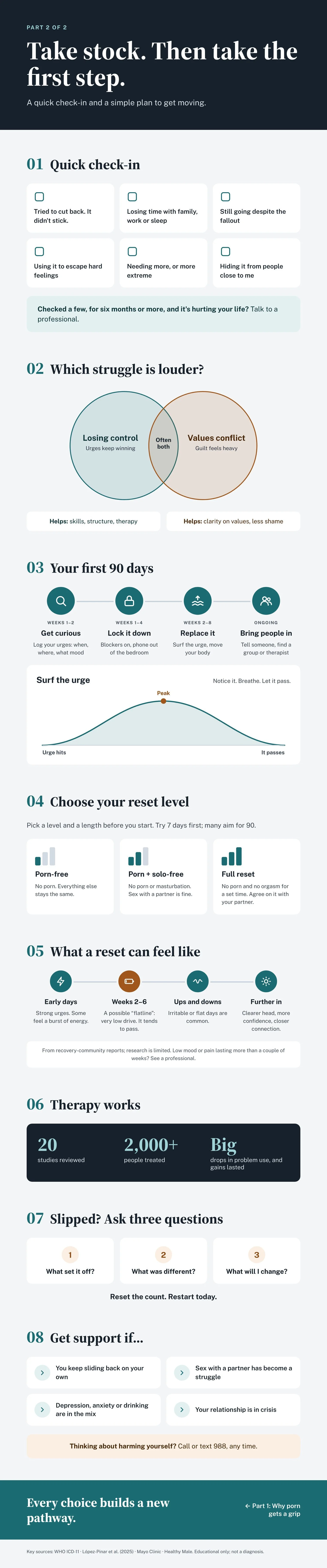
Find your window. For seven days, write down when the urge hits: time, place, mood. Most men see a pattern by the end of the week.
Delay 10 minutes and name it. When the urge shows up, set a timer. Say what you’re feeling out loud or on paper: tired, angry, lonely, bored. Urges peak and pass. You’re practicing letting one pass.
Write down the dad you want to be. Three sentences. What do you want your kids to say about how you handled hard things? Keep it on your phone and read it in the window.
The infographic below lays out a simple first 90 days.
When to get help
If you keep sliding back after trying to cut down, if it’s costing you sleep, work, or your relationship, or if the shame has become its own weight, it’s worth talking to someone. Same if depression, anxiety, or drinking are in the mix. If you’re having thoughts of harming yourself, call or text 988, any time.
At Cedarpath, the first session is a conversation. No label in session one. We figure out what’s going on, what you want, and whether we’re a fit. Some men want to quit. Some want control back. You decide.
Related: Is It Porn Addiction, or Normal Porn Use?
Learn more about therapy for problematic porn use, or book a free consultation.
Sources: WHO ICD-11, 6C72 Compulsive sexual behaviour disorder; Grubbs, Perry, Kraus, Lewczuk & Gola (2020), Journal of Abnormal Psychology, via the American Psychological Association. Educational only; not a diagnosis.
